Case Study: Using SBR to Avoid Liquidation and Reduce ATO Debt
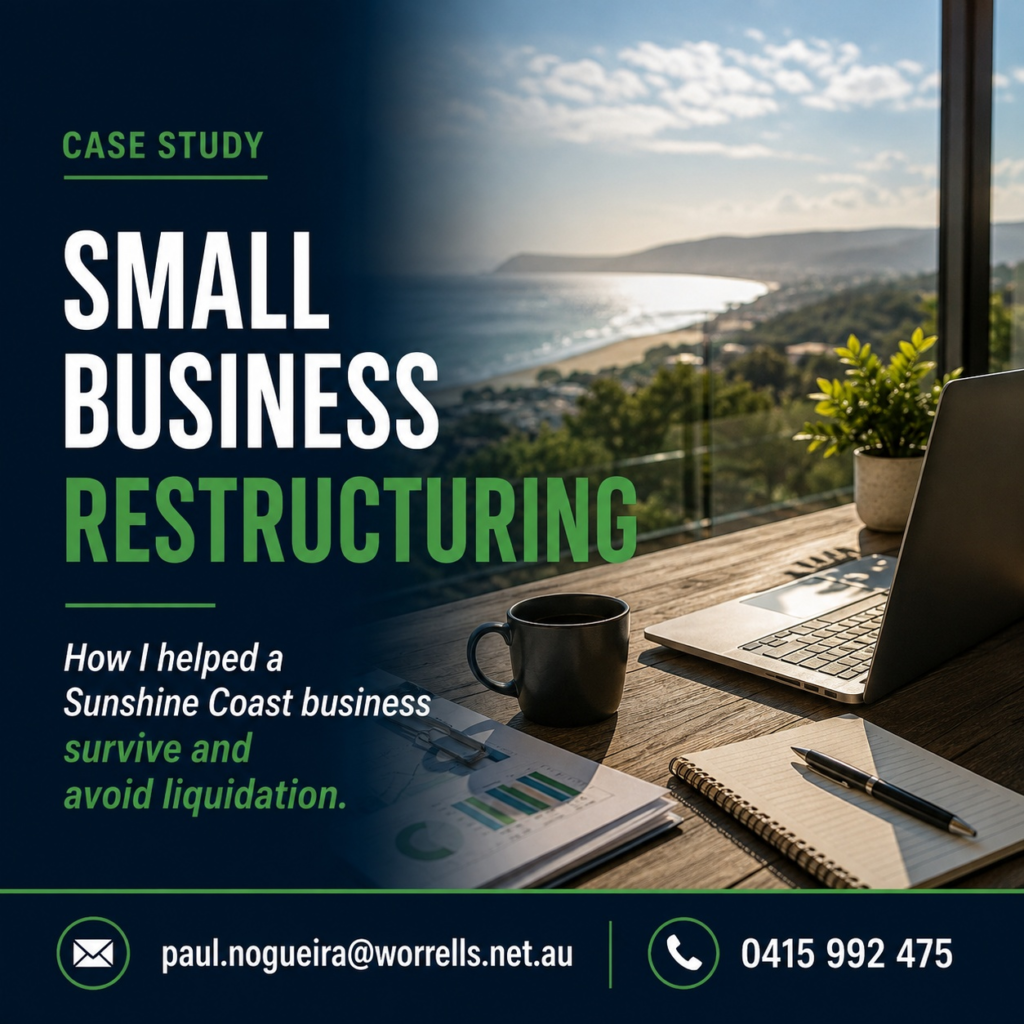
How I Helped a Sunshine Coast Business Avoid Liquidation
A business can be viable and still end up with a tax debt it simply cannot repay.
That was the position with a Sunshine Coast business I recently assisted.
The company was still trading and had a future, but it had accumulated a significant debt to the Australian Taxation Office (ATO).
The ATO was its only creditor and, without a solution, liquidation was a very real possibility.
Small Business Restructuring (SBR) gave the director another option.
The end result was an accepted restructuring plan at 40 cents in the dollar, which provided a 60% reduction in the company’s debt, with the agreed amount payable over approximately two and a half years.
More importantly, the company avoided liquidation and continues to trade.
So how did I handle the matter?
First, Work Out Whether the Business Is Worth Saving
An SBR only makes sense if there is a viable business underneath the debt.
Before talking about cents in the dollar, the first job is to understand how the business is actually performing.
Can it pay its ongoing expenses?
Can it meet its tax and superannuation payments going forward?
Can it afford the restructuring payments without putting itself straight back into financial trouble?
There is no point restructuring yesterday’s debt if the business is simply going to create the same problem again tomorrow.
In this case, the underlying business was viable.
The issue was dealing with the existing ATO debt in a way the company could realistically afford.
Then Work Out What the Business Can Actually Pay
The next step was working out a reasonable offer.
Too low and there is little reason for the creditor to support it.
Too high and the company may simply fail under the weight of the restructuring plan.
We worked through the company’s budget with the director and arrived at a contribution that gave the business room to keep trading while still providing the ATO with a better outcome than liquidation.
In this case, the likely return to the ATO in a liquidation was nil.
That does not mean you simply put forward any number and expect the ATO to accept it.
The proposal still needs to stack up commercially and provide a meaningful return.
Talk to the ATO Before Putting the Plan Forward
Rather than simply issuing the restructuring plan and waiting for the result, I provided the ATO with a draft of the proposed plan beforehand.
That gave the ATO an opportunity to consider the proposal and provide some feedback.
In this case, the ATO wanted some more money.
We went back to the numbers, looked at what the company could realistically afford and adjusted the proposal.
The revised plan was then put forward and ultimately accepted.
Fixing Problems on the fly
Not everything goes perfectly to plan.
Before a restructuring plan can be put forward, certain employee entitlements need to be up to date.
When the appointment started, no outstanding superannuation was disclosed.
Then, about three days before the restructuring plan was due to be issued, we discovered there was superannuation owing to the directors.
That had to be dealt with quickly.
We worked through the issue, got it resolved and were still able to issue the restructuring plan within the required timeframe.
It was a good reminder of why the position needs to be carefully reviewed before starting an SBR.
The tighter the timeframe, the less room there is for surprises.
The repayment period can make or break a proposal
An SBR restructuring plan can run for up to three years.
In my experience, the ATO generally prefers a shorter repayment period, often around two years.
In this matter, we needed two and a half years to make the numbers work.
That extra six months made a real difference to the company’s cash flow and its ability to meet the payments.
We were concerned the ATO might resist the longer timeframe, so we made sure the proposal clearly explained why the additional six months was needed and why it still produced a better outcome than liquidation.
In the end, the ATO accepted the proposed timeframe.
The Result
The ATO accepted 40 cents in the dollar.
The company achieved a 60% reduction in its outstanding debt.
The agreed amount is being paid over approximately two and a half years.
The ATO receives significantly more than it was likely to receive in a liquidation.
And the business continues to trade.
For me, that is what an SBR should be about.
It is not simply about trying to reduce a tax debt.
It is about working out whether there is a viable business worth preserving, dealing with any problems that stand in the way, putting forward a proposal the company can actually afford and giving creditors a commercial reason to support it.
Considering Small Business Restructuring?
Small Business Restructuring can provide eligible companies with an opportunity to compromise debts while the directors remain in control of the business.
For more information about the process, eligibility and how I can assist, see my Small Business Restructuring service page.