What is bankruptcy?
Overview
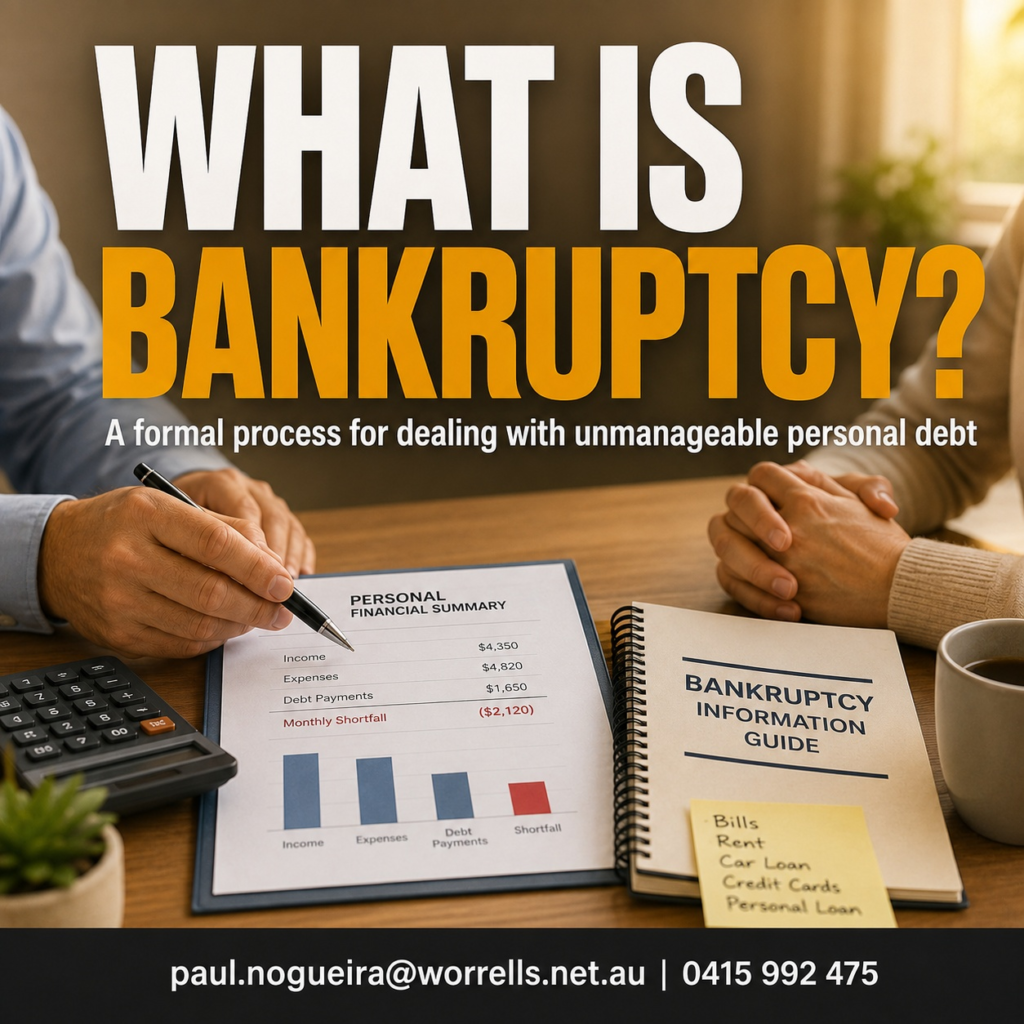
Bankruptcy is a formal legal process for dealing with the financial affairs of an individual who cannot pay their debts.
It is sometimes described simply as a way to obtain relief from debt. That description is incomplete. Bankruptcy also transfers control of certain property to a trustee, changes how creditors may enforce their claims, requires an investigation of the bankrupt’s financial affairs and may result in contributions being paid from income.
The process is governed by the Bankruptcy Act. It applies to individuals, including sole traders and partners. A company cannot become bankrupt. Companies are dealt with under the corporate insolvency provisions of the Corporations Act.
Bankruptcy and insolvency are not the same thing
A person is insolvent when they cannot pay their debts as and when they become due and payable.
This is principally a cash-flow test. A person may own assets worth more than their liabilities and still be insolvent if those assets cannot be sold or refinanced in time to meet debts that are presently due.
Bankruptcy is the legal process that may follow. It does not arise merely because someone is insolvent. A person becomes bankrupt after either:
- the Official Receiver accepts their debtor’s petition; or
- a court makes a sequestration order on the application of a creditor.
The distinction can be important where a person owns substantial but illiquid property. Having equity in a house, business or investment does not necessarily prevent bankruptcy if the person has no presently available means of paying their debts.
How bankruptcy begins?
Voluntary bankruptcy
A person may apply for their own bankruptcy by lodging a debtor’s petition and Statement of Affairs.
The debtor’s petition is the formal application. The Statement of Affairs provides details of the person’s assets, debts, income, employment, businesses, property dealings and interests in associated entities.
A registered bankruptcy trustee may consent to administer the estate. Where a private trustee is not chosen, the Official Trustee generally administers the bankruptcy initially.
The Official Receiver has a separate statutory role and is responsible for functions such as considering the debtor’s petition and maintaining the personal insolvency registry.
Bankruptcy initiated by a creditor
A creditor may apply to the court for a sequestration order.
The usual process begins with the creditor obtaining a judgment and serving a bankruptcy notice. Failure to comply with the notice may constitute an act of bankruptcy, allowing the creditor to present a creditor’s petition.
The expiry of a bankruptcy notice does not itself make the debtor bankrupt. Bankruptcy begins when the court makes the sequestration order.
A person made bankrupt by court order must subsequently lodge a Statement of Affairs. The timing of that lodgement affects when the ordinary period of bankruptcy will end.
The immediate effect of bankruptcy
Bankruptcy produces several legal changes at the same time.
First, divisible property owned by the bankrupt generally vests in the bankruptcy trustee under section 58 of the Bankruptcy Act. The trustee becomes responsible for controlling and dealing with that property.
Second, unsecured creditors with provable debts are generally prevented from continuing their individual recovery action. Their remedy is ordinarily to lodge a proof of debt and participate in any dividend paid from the estate.
Third, the trustee begins an investigation into the bankrupt’s financial affairs. This can extend beyond the assets listed in the Statement of Affairs and may include companies, trusts, related parties and transactions entered into before bankruptcy.
Secured creditors remain in a different position.
Property that passes to the trustee
The property available to creditors is referred to as divisible property.
It generally includes property owned at the commencement of bankruptcy, such as:
- houses and land;
- money in bank accounts;
- shares and investments;
- cryptocurrency;
- business assets;
- valuable personal property;
- debts owed to the bankrupt;
- intellectual property; and
- legal and beneficial interests in property.
Vesting occurs by operation of law. The trustee does not need to take physical possession of an asset before the estate obtains an interest in it.
Some assets require an additional registration step before the trustee can deal with them. For example, a trustee may enter transmission on the title to real property so that the trustee becomes the registered owner in place of the bankrupt.
The trustee is not limited to property registered in the bankrupt’s name. The trustee may investigate whether the bankrupt has a beneficial or equitable interest in property legally held by someone else.
The Bankruptcy Act prescribes time limits for a trustee to deal with divisible property and when that property may revest in a bankrupt.
Property received during bankruptcy
Property acquired after bankruptcy but before discharge may also vest in the trustee. This is commonly called after-acquired property.
Examples can include:
- an inheritance;
- lottery winnings;
- shares or other investments received as a gift; and
- valuable property acquired during bankruptcy.
The relevant date is often when the bankrupt becomes legally entitled to the property, rather than when it is eventually paid or transferred.
An inheritance may therefore vest in the trustee where the person whose estate gives rise to the inheritance dies before the bankrupt is discharged, even if the deceased estate is not distributed until much later.
A bankrupt must notify the trustee when they acquire, or become entitled to, new property.
Property that is protected
Bankruptcy does not mean that every asset is sold.
Section 116 excludes specified property from division among creditors. Protected property commonly includes:
- ordinary household furniture and effects;
- necessary clothing;
- tools used to earn income, up to an indexed limit;
- vehicles used for transport, up to a combined indexed limit;
- certain life assurance and endowment interests;
- certain personal injury and compensation payments;
- prescribed sentimental property;
- certain property acquired with protected money; and
- interests in regulated superannuation funds, subject to the recovery provisions.
The applicable limits are indexed and change periodically.
Superannuation requires particular care. An interest remaining in a regulated superannuation fund will generally be protected, but contributions made before bankruptcy may be recovered where the purpose was to place property beyond the reach of creditors.
Income is treated separately from property
A bankrupt can continue working, operating as a sole trader and earning income.
Bankruptcy does not generally prevent a person from remaining employed, although separate professional, licensing or occupational rules may apply.
Income earned after bankruptcy does not ordinarily vest in the trustee in the same way as property owned at the date of bankruptcy. Instead, it is dealt with under the income contribution regime.
Where assessed income exceeds the statutory threshold, the bankrupt must pay a contribution to the estate. The threshold depends on the number of dependants and is indexed.
The definition of income for bankruptcy purposes is wider than taxable income. It may include salary, business income, trust distributions, pensions, annuities, fringe benefits and certain payments or benefits provided by third parties.
The trustee assesses the liability for each contribution assessment period. An assessment may be revised if the bankrupt’s income, allowable deductions or number of dependants changes.
An unpaid contribution remains recoverable after discharge. The trustee may use enforcement mechanisms including garnishee notices or the supervised account regime.
There is also an important distinction between income and property purchased with income. Post-bankruptcy earnings may not themselves vest, but an asset purchased with those savings before discharge may become divisible property.
The family home
A principal place of residence is not protected merely because the bankrupt or their family lives there.
The bankrupt’s interest in the property generally vests in the trustee. The trustee will usually obtain a valuation, determine the secured liabilities and selling costs, and calculate the equity available to the estate.
Where the bankrupt owns the property jointly with another person, only the bankrupt’s interest initially vests. The non-bankrupt co-owner retains their own interest.
The trustee will ordinarily give the co-owner an opportunity to:
- purchase the estate’s interest; or
- participate in an agreed sale of the property.
If no satisfactory agreement can be reached, the trustee may seek court orders that result in the whole property being sold. The fact that a co-owner is not bankrupt does not necessarily prevent a sale.
The registered ownership is usually the starting point when calculating the parties’ interests. It may not be the final position. Resulting trusts, constructive trusts and the doctrine of exoneration may affect the division of equity where the parties made unequal contributions or borrowings secured over the property were used solely for one owner’s benefit.
A property with no equity at the commencement of bankruptcy is not automatically returned to the bankrupt. It may remain vested, subject to the statutory revesting provisions, allowing the estate to benefit from later capital growth or reductions in the mortgage.
Companies, trusts and business interests
The assets of a company do not become assets of the bankrupt estate merely because the bankrupt is a director or shareholder.
The shares owned by the bankrupt may vest in the trustee. The company’s property remains the company’s property. The trustee’s job is to determine if those shares have any value and how to best realise same.
The bankrupt is also disqualified from managing a corporation while undischarged unless the court grants leave. This can materially affect a business that depends upon the bankrupt continuing as its director.
Trust interests require a similar distinction. Property held on trust for another person is generally excluded from the bankrupt estate. However, the trustee may investigate:
- units in a unit trust;
- fixed trust entitlements;
- unpaid distributions;
- loans owed to the bankrupt;
- rights of indemnity or exoneration;
- property transferred to the trust; and
- benefits arising from services supplied by the bankrupt.
Transactions before bankruptcy
A bankruptcy trustee is required to look beyond the financial position that exists on the date of bankruptcy and examine certain transactions entered into beforehand.
Depending on the circumstances, the trustee may investigate and seek to recover transactions including:
- Section 120 — transfers of property for less than market value;
- Section 121 — transfers intended to defeat, delay or hinder creditors;
- Section 122 — payments or transfers that give one creditor a preference over others; and
- Sections 128B and 128C — certain superannuation contributions made to defeat creditors.
Whether a transaction can be recovered will depend on the facts, when it occurred and the particular requirements of the Bankruptcy Act.
See my article, https://paulnogueira.com.au/void-transfers-in-bankruptcy/, for further information about these provisions.
The creditor position
A creditor with a provable debt may lodge a proof of debt in the bankrupt estate.
The trustee must decide whether to:
- admit the claim;
- admit only part of it;
- request further evidence; or
- reject it.
If funds become available, the trustee distributes them in the order prescribed by section 109. After the costs and priority claims are dealt with, ordinary unsecured creditors generally share proportionately.
A secured creditor may continue to rely on valid security. Depending on the circumstances, it may enforce the security, surrender it and prove for the full debt, or value the security and prove for an anticipated shortfall.
The distinction between a provable debt and a debt released at discharge is important. They are not the same question.
Most unsecured debts incurred before bankruptcy are provable and are released on discharge.
However, some debts are provable but are not released, including certain liabilities arising from fraud and child support or maintenance. Other liabilities, such as HECS or HELP debts and court-imposed fines for offences, are generally non-provable and remain payable.
Bankruptcy releases the bankrupt from relevant debts. It does not release a guarantor, joint borrower, partner or other person who is separately liable.
Restrictions and obligations
During bankruptcy, the bankrupt must disclose their financial affairs and cooperate with the trustee.
This includes notifying the trustee of changes in income, employment, address, assets, inheritances and legal proceedings.
An undischarged bankrupt must also:
- obtain the trustee’s written consent before travelling overseas;
- disclose the bankruptcy when applying for credit above the indexed amount;
- disclose the bankruptcy when trading under certain business names;
- provide requested books and financial information;
- pay assessed income contributions; and
- refrain from managing a company.
A bankrupt is not automatically required to surrender their passport. The restriction is that they must not leave Australia without the trustee’s written permission.
Failure to comply may constitute an offence, lead to enforcement action or provide grounds for an objection to discharge.
Discharge does not end the estate
Bankruptcy ordinarily ends automatically three years and one day after:
- acceptance of the debtor’s petition; or
- acceptance of the Statement of Affairs in a court-ordered bankruptcy.
A trustee may lodge an objection to discharge on one or more statutory grounds. Depending on the ground, the bankruptcy may be extended to five or eight years.
Discharge ends the person’s status as an undischarged bankrupt. It does not necessarily complete the administration.
After discharge, the trustee may still:
- sell property that remains vested;
- pursue recovery proceedings;
- complete investigations;
- collect outstanding income contributions;
- determine creditor claims; and
- pay dividends.
The former bankrupt also has a continuing obligation to provide reasonable assistance to the trustee.
This distinction is regularly overlooked. The bankruptcy period may have ended, but the property and administration of the estate can continue for considerably longer.
Annulment of bankruptcy
An annulment is different from discharge.
Discharge ends the bankruptcy after the applicable statutory period. Annulment cancels the bankruptcy because a specified event has occurred.
A bankruptcy may be annulled where:
- the debts, administration costs and statutory charges are paid in full under section 153A;
- creditors accept a composition or arrangement under section 73; or
- the court orders an annulment because the bankruptcy should not have occurred.
Annulment does not generally undo valid actions already taken by the trustee. A sale, recovery or other transaction completed during the bankruptcy will ordinarily remain effective.
Public record and credit history
Bankruptcy is not a private process.
Details of the bankruptcy are recorded on the National Personal Insolvency Index, commonly called the NPII.
The NPII is a publicly searchable register maintained by the Official Receiver. A bankruptcy record generally remains on the NPII permanently, even after the person has been discharged.
Bankruptcy will also appear on the person’s credit report.
This may make it more difficult to obtain finance or other services where a credit assessment is undertaken.
After discharge, a person may apply for credit, but the decision whether to lend remains with the credit provider.
While the person remains bankrupt, they must also disclose their bankruptcy when applying for credit above the indexed statutory amount.
Bankruptcy is one option, not the only option
Bankruptcy can provide an effective resolution where a person has no realistic capacity to pay or compromise their debts.
It may also expose property, affect a business structure, create income contribution liabilities and lead to claims against family members or associated entities.
Possible alternatives include an informal settlement, a Part IX debt agreement or a Part X personal insolvency agreement. Their suitability depends on the debtor’s income, assets, creditors and ability to fund a proposal.
The position is usually easier to manage before a bankruptcy notice expires, property is transferred or court proceedings reach a final hearing. At that stage, there is generally more scope to compare the available outcomes rather than simply respond to a process already underway.
Need assistance?
If you need assistance with the issues discussed in this article, you can find out more about the relevant service below or contact me directly.